
Therapists Receive Certification in Specialized Therapy for Patients with Parkinson’s Disease
April 22, 2016TCMH Managers Graduate from MHA Leadership Series
May 16, 2016Texas County Memorial Hospital ended 2015 with a net position of -$2,071,369 in excess revenues over expenses hospital board members and administration heard at their monthly meeting on Tuesday.
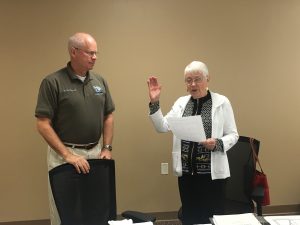
Texas County Memorial Hospital board of trustees chairperson, Dr. Jim Perry, OD (left), administered the oath of office to Omanez Fockler, returning board member at the meeting on Tuesday.
Stephanie Weis, partner at BKD, LLP of Springfield, MO and David Taylor, senior manager at BKD, presented the annual audit report at the monthly meeting.
“2015 was an atypical year for operating results,” Weis said, citing the loss of two doctors in the first quarter of 2015, which led to lower operating revenues of $1,848,391.
Audit results also showed that expenses at the hospital dropped by $475,145 in 2015, which Taylor described as “not common”.
“A substantial portion of expenses are fixed in a hospital of your size,” Taylor said. “It’s very hard to be responsive to volume changes, but you were able to control expenses that were controllable.”
In 2015, grants and donations to the TCMH Healthcare Foundation totaled $619,196. In 2014, grants and donations totaled $1,180,978. Although the Healthcare Foundation funds are designated for specific purposes, the numbers are included in overall year end fiscal results.
“The funds you have received for grants and donations are very strong,” Taylor said. “Numbers like these are not typically seen in a hospital of your size.”
Although revenues at the hospital were down in 2015, TCMH continued to invest in the hospital with capital purchases totaling $500,940.
TCMH made principal payments of $747,356 on the major construction project completed in 2014, and depreciation expenses made up a good portion the hospital’s losses in 2015.
“A lot of this year’s loss is related to depreciation,” Taylor said. “If you take out the depreciation, 2015 showed a ‘true decrease’ of about $450,000.”
The audit report showed a decrease in accounts receivable of over 12 percent for 2015, most of which is third-party insurance collections for clinic-based billing. Auditor called the decline “favorable”.
“Our report shows that you are doing what you can to watch any funds that are going out the door,” Taylor said.
TCMH had 83 days of cash on hand—the days the hospital could operate without bringing in any funds. The rural Missouri hospital average is approximately 50 days of cash on hand.
Construction projects at TCMH have the average age of the hospital facility down to about 10 years which is at or below Missouri hospital averages.
The debt to capitalization ratio at TCMH is at 50 percent, which Taylor called “not too high”. TCMH is in line with other hospitals in the nation.
“Your balance sheet is good, and your financial position is strong,” Taylor told board members.
Taylor pointed out that revenue from the 340b pharmaceutical program helped offset losses in 2015, and he noted that TCMH plans to grow those revenues in 2016. Additionally, TCMH has hired Dr. Cory Offutt, a family medicine and obstetrics physician that will begin working full-time in the hospital and clinic in July.
In 2015, TCMH brought $14,127,908 in Medicare and Medicaid funds into the hospital. Due to the patient population in the area TCMH relies heavily on federal funds.
Taylor spoke to board members about the shift that hospitals are experiencing as Medicare makes payments for healthcare related to value rather than volume.
“TCMH experienced some value-based payments in 2015, and there are more of those to come in the future,” Taylor said.
Taylor explained that understanding the financial path for risk-based reimbursement versus the traditional fee for service payment method is not entirely known.
Beginning this April, a pilot program for hip and knee replacement was put into place in major-metro areas of the state. Hospitals are given a bundled bulk payment for the joint replacement, and with the joint replacement, the hospital assumes a 90-day responsibility for the patient post-discharge.
“The bottom line for each joint replacement is dependent upon improving the outcome of the patient,” Taylor said. “This is forcing conversations on the coordination of care for patients.”
Taylor and staff at BKD anticipate that more healthcare procedures and services will be placed into “bundled” payments, placing the hospitals at risk financially.
As a result of the anticipated changes to the payment delivery methods for the hospitals they serve, BKD has hired non-CPA staff to help the accounting firm better understand the clinical side of the business.
BKD sends an audit team to TCMH each March, spending about a week pouring over hospital financial information from the previous year. The firm takes about a month to complete the audit information including expense statements, balance sheets, statement of cash flows and other information that comprises the financial report documents presented at the April board meeting.
BKD uses historical TCMH data and data from other healthcare facilities for comparison purposes during the audit. BKD also has access to the latest information regarding hospital payers which helps the firm reach concrete numbers in the final audit report.
“As our numbers show, there was not a significant change from the numbers you reported internally to those we are reporting,” Weis said. “You did a good job making decisions throughout 2015 based on your internal results.”
In the hospital administrative report, Wes Murray, chief executive officer, explained that he and Joleen Senter Durham, physician recruiting director at TCMH, visited the Cox Family Medicine Residency Program in Springfield where they talked with residents about TCMH.
“We had a very productive meeting and provided lunch for about 15 people,” Murray said, adding, “We spoke with them about moonlighting in the ER, rural residency rotations in the clinic or surgery department, weekend hospitalist work, and full-time opportunities after residency.”
Durham noted that several of the current residents have roots in the Ozarks.
“Most residents will take a job within 100 miles of where they complete residency,” Durham said. “We are very fortunate that Cox allows us the opportunity to meet with their residents regularly.”
Ron Prenger, CoxHealth representative, pointed out that the Cox residency program was recently allowed to add an additional resident, and the program hopes to add more slots for residents in the future.
Linda Pamperien, chief financial officer at TCMH, presented the financial report for the month of March.
“Inpatient volumes were below budgeted expectations, but outpatient volumes were above budgeted expectations for an overall revenue of $23,261,” Pamperien said.
Due to Medicaid payment remittance for three weeks instead of two in the month of March, contractual adjustments were higher, coming in at almost 68 percent.
With the higher contractual adjustment, TCMH ended the month of March with negative bottom line of $132,017.53, creating a neative year-to-date bottom line of $35,996.74.
Present at the meeting were Weis; Taylor; Murray; Pamperien; Durham; Prenger; Anita Kuhn, controller; Dr. Jonathan Beers, TCMH chief of staff; and board members Jim Perry; Mark Hampton; Omanez Fockler, and Janet Wiseman.
The next meeting of the TCMH board of trustees is Tue., May 24 at 12 p.m. in the hospital board room.