
Christie Koch is Employee of the Month
April 12, 2016Annual Hospital Audit Shows Strong Financial Position Despite Year End Loss
April 29, 2016Area residents with Parkinson’s disease have the opportunity to receive LSVT BIG, a specialized physical therapy available through Texas County Memorial Hospital and TCMH Home Health of the Ozarks.
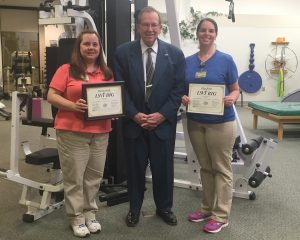
Christie Koch, left, and Ellen Willis, right, have received their LSVT BIG certification. Cabool resident and former Texas County judge, Brad Ellsworth, has worked with the TCMH Physical therapy department for Parkinson’s disease-related therapy, but he hopes to utilize the LSVT BIG therapy in the future.
“I am very excited to be able to offer this therapy for our patients,” Willis said, explaining that she and Koch jumped at the opportunity to get the training when it was recently offered in Missouri.
The training included work with a community volunteer, and Willis noted that even in the short time of working with the volunteer during the training program, the volunteer showed improvement in their movement.
“LSVT BIG specifically addresses amplitude of movement with patients suffering from Parkinson’s disease,” Willis said.
Willis explained that Parkinson’s disease—a neurological process that affects the brain’s ability to receive dopamine—can start in patients as young as 30 or 40 years old.
“We are not exactly sure what causes Parkinson’s disease,” Willis said. She explained that Parkinson’s disease symptoms include muscle rigidity, tremors, and changes in speech and gait. After diagnosis, treatments can help relieve symptoms, but there is no cure.
According to Willis, there are five stages to Parkinson’s disease, and any therapy a patient receives in the early stages of the disease can help delay the disease’s progression.
“The greatest improvement with the BIG therapy for Parkinson’s patients is in stages one through three, but it can be done in any stage,” Willis said.
With the new certification, Willis will do LSVT BIG therapy in the hospital physical therapy department, and Koch will do LSVT BIG therapy with patients in their home. Willis will also do in-home assessments with Home Health of the Ozarks patients before Koch implements the therapy program.
“We have had many patients at TCMH that would benefit from BIG therapy, and it’s important that those in the beginning stages of Parkinson’s disease understand that early intervention is very important,” Willis said.
Parkinson’s disease slows a person’s movement and speech. It’s not uncommon that handwriting will become smaller, speech will become softer, walking and other movement will be slower and less animated. Ultimately, Parkinson’s disease will completely cripple a patient making the person unable to move and speak.
“BIG therapy identifies the specific needs of each patient such as shaving, removing a wallet, putting on socks and shoes, walking, and more in the initial assessment,” Willis said. “We develop a therapy program of seven exercises along with functional activities that we do with the patient for 16 one-hour sessions—four consecutive days a week for four weeks.”
The patient is asked to practice their exercise program at home during the therapy regimen. After the prescribed program is complete, the patient continues their daily exercises at home, checking in for a “tune up” in three to six months and meeting with a therapist as needed.
“It’s amazing to watch the changes in a patient before and after therapy,” Willis said. She described a Parkinson’s patient with a shuffling gait before therapy, and after therapy the patient will swing his or her arms while taking steps and holding their head up.
“BIG therapy carries over to other facets of the disease, too, improving speech and handwriting because of better movement techniques that carry over from therapy,” Willis said.
According to Willis LSVT BIG therapy can benefit patients for up to two years.
“The therapy program calibrates internal movement cues,” Willis said.
Willis noted that many Parkinson’s patients are home bound or they cannot easily travel to the hospital for therapy, so Koch will do LSVT BIG therapy in the home following Willis’ initial assessment of the patient in his or her home.
Like all physical therapy, a patient must receive a doctor’s order for the initial assessment.
“Most insurance will cover BIG therapy,” Willis said. She noted that some of the therapy techniques used for BIG therapy are also valuable for use with other neurologic disorders.
“Christie and I are looking forward to bringing BIG therapy to patients in the area for the first time,” Willis said.
Depending upon the need for BIG therapy, Willis hopes to have other TCMH physical therapy staff train and receive their LSVT BIG certification in the future.
For additional information about LSVT BIG therapy, contact the TCMH physical therapy department at (417) 967-1201.