
Healthcare Foundation Awards Scholarships
March 1, 2013Flores Named Employee of the Month
March 15, 2013The Texas County Memorial Hospital board of trustees gave unanimous approval to proceed with obtaining bids for the planned tornado safe room and surgery department at their monthly meeting on Tuesday.
Separate bids for each portion of the new construction will be sought to allow the hospital greater flexibility with the project.

An architectural rendering of the tornado safe room entrance.
The TCMH Healthcare Foundation has been raising $3.2 million toward the tornado safe room and the surgery department since 2011 as part of the “Care for Your Future” capital campaign.
“We are short of our goal in pledges and donations for the project,” Wes Murray, chief executive officer at TCMH, said, “But we can continue to raise funds for the project while we collect bids.”
Jay Gentry, TCMH Healthcare Foundation director, and members of the capital campaign project, have been targeting donations from businesses and organizations. Over $2.7 million has been raised toward the project. The construction portion of the project and the demolition of the current South wing to make room for the new construction is projected to cost $3 million.
“These figures do not include the furniture and fixtures for the safe room and for the asbestos abatement in the South wing,” Murray said.
TCMH is bidding the project in separate portions to allow some of the work to be completed in house in order to save funds on the construction portion of the facility.
“We are short of the funds needed to achieve our goal, but by scaling back a little bit, we come much closer to the amount that has been raised and pledged,” Murray said.
The construction plan for the tornado safe room has been submitted to the Federal Emergency Management Association to allow up to four months for review for the plan. Construction of the tornado safe room is expected to take 14 months to complete with a deadline of November 2014 for completion.
“We need to proceed with construction bids at this time if we are going to meet FEMA’s deadlines for the project,” Murray said.
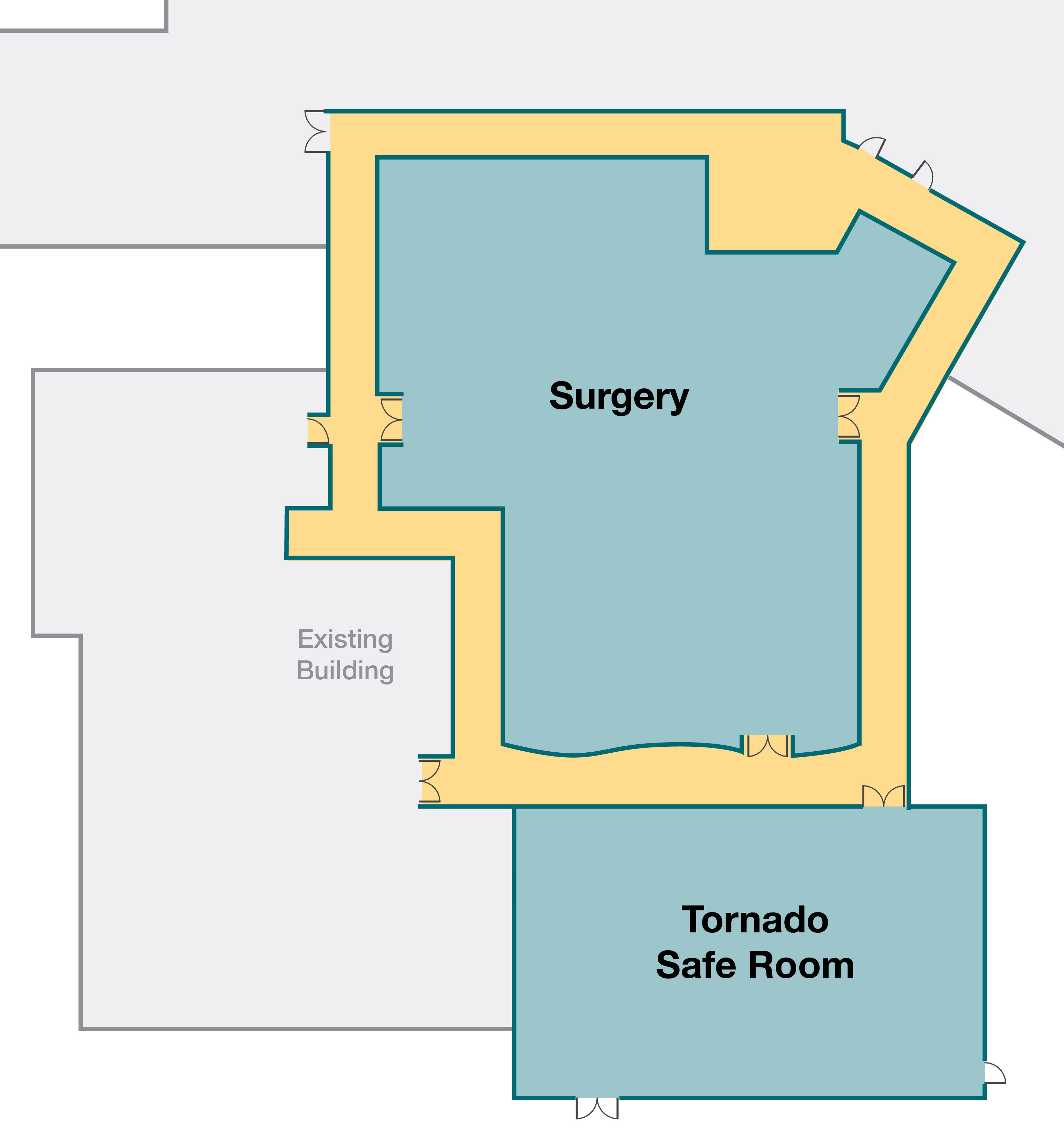
A floor plan showing approximate structure of the tornado safe room and the new surgery department.
FEMA has approved a $562,000 grant toward building the tornado safe room. TCMH was the first hospital in state to receive funds for a tornado safe room structure.
The tornado safe room will have 4,000 square feet of climate-controlled space that can be utilized as waiting space during non-threatening weather times. During threatening weather, the room will be capable of sustaining 250 mile per hour winds for two hours as well as providing shelter for up to 462 patients, staff members and community residents. The tornado safe room at the hospital will enhance the hospital’s capabilities for triage during times of mass casualty as well as supplying an additional generator with backup power.
In addition to the funds from FEMA toward the tornado safe room, TCMH received a $298,000 Community Development Block Grant from the Missouri Department of Economic to assist with the construction and finishing details of two community meeting room spaces when there is no threatening weather.
The new surgery department will double the size of two operating rooms and add an outpatient surgery room for 6,091 of climate controlled space. The latest technology will be incorporated in the building and design of the new department to increase operating room efficiency. Seven private pre- and post-surgery bays will be part of the new department, increasing privacy for patients and their family members and allowing for infant/parent bonding following C-sections.
“Utilizing some in-house construction will help us accomplish our overall goal and save us some money,” Murray said.
Board members also unanimously passed a resolution in favor of Medicaid expansion in Missouri.
The Patient Protection and Affordable Care Act provides all states the opportunity to expand state Medicaid coverage. This Medicaid expansion would provide coverage to previously uninsured individuals. Currently, Missouri legislators are considering whether to participate in the Medicaid expansion program.
“We support this expansion in light of what it would mean for providing care for the citizens of Texas County and what it means for our hospital revenues,” Omanez Fockler, chairperson of the TCMH board of trustees, said.
According to the Missouri Hospital Association (MHA), in 2014, more than 24,000 jobs could be created if Missouri participates in the Medicaid expansion plan included in the Affordable Care Act. Research from the University of Missouri found that expansion could add $9.6 billion to the state’s economy in value-added output in 2014 — increasing gross state product by more than one-half percent.
The University of Missouri research also found that not expanding Medicaid could cost Missouri more than 9,000 jobs, $1.9 billion in reduced capital investment or $1.1 billion in cost shift to the insured. This forecast is based on cuts included in the Affordable Care Act and Budget Control Act of 2011, which when combined, reduces hospital reimbursement by $4 billion between 2013 and 2019.
According to the university’s research, if Medicaid is expanded, as many as 220,000 enrollees would be eligible for the program, significantly reducing the number of the uninsured in the state. Between 2014 and 2020, the federal portion of this state-federal program would cover 96.1 percent of the cost.
“Medicaid expansion has a huge impact on TCMH,” Murray said, explaining that “the vast majority of those receiving Medicaid coverage through expansion are those who work but do not have access to or cannot afford health insurance”.
Murray explained that in the past TCMH has received additional federal dollars due to the number of Medicaid patients seen at the hospital through a “disproportionate share” program. Those additional funds are going away under the Affordable Care Act.
“This expansion will help soften the blow of losing the disproportionate share,” Murray said.
Dr. John Duff, CoxHealth representative, agreed with Murray’s assessment.
“Rural hospitals, which see more Medicaid patients than hospitals in bigger communities, are hit doubly hard by losing the disproportionate share,” Duff said.
Murray described the Medicaid expansion as “affecting our business interests”.
“We have a growing number of working people that are not able to pay their hospital bills,” Murray said.
In 2011, TCMH provided $5.6 million in uncompensated care to patients in the county.
“We as a hospital are here to provide health to the citizens of Texas County, and we have to consider how our revenue is affected by Medicaid,” Fockler said. “We have to encourage the state legislature to approve this expansion regardless of our political persuasion.”
Murray has spoken with state legislators regarding Medicaid expansion and its effects on TCMH.
“We service the healthcare needs of a growing number of people that work but do not have or cannot afford health insurance,” Murray said. “We need to be sure our legislators understand how Missouri Medicaid expansion affects the business interests at TCMH.”
Duff told board members that the CoxHealth board has passed a resolution supporting Missouri Medicaid expansion. In addition to CoxHealth, TCMH joins Ozarks Medical Center in West Plains, Salem Memorial District Hospital and other hospitals around the state in supporting the expansion.
Murray reported that the TCMH Medivan, the non-emergency transportation service operated by TCMH, has a contract in hand to contract with Medicaid to provide transportation for Medicaid patients.
“There are many occasions that we provide transportation without any reimbursement,” Murray said, recounting the story of a hospital patient that was discharged at 4 p.m. on a Saturday and at 11 a.m. on Sunday, the patient was still waiting for the Medicaid transportation service to provide a ride home.
“The Medivan will not provide services all over the state like some Medicaid transportation services,” Murray said. “We will be able to provide the service to TCMH patients and receive some reimbursement for the service.”
Paint, tile, flooring and ceiling tiles are part of the current TCMH expansion progress. “Cabinetry is being delivered for installation, and doors are going in,” Murray said.
According to Murray, the weekly “owners, agent, contractor” meetings are beginning to focus on the remodeling portion of construction that will take place inside the current hospital as certain departments are moved to the new construction.
“JE Dunn is asking the subcontractors to be proactive about looking for potential obstacles they might encounter in the current hospital which has portions that have been built from the 1960s to 1990s,” Murray explained.
In March TCMH is planning to hold a “thank you” barbeque lunch for the subcontractors.
“It will be an opportunity to provide lunch and to thank the subcontractors for the work they have done,” Murray said.
TCMH will also provide tours of the current construction to hospital employees during the lunch.
“It’s hard to keep our employees out of new construction right now,” Murray said. “There is a growing feeling of excitement among the staff.”
TCMH staff has also been looking at area urgent care and fast track emergency room models with plans of offering a faster care model for non-emergency patients in the new emergency department during peak times.
Current peak times in the TCMH ER are typically on weekends when there are no other healthcare options available in Texas County other than the emergency room. Forty-six percent of ER visits at TCMH are primary care-related health concerns rather than emergency healthcare needs.
“We anticipate that our volumes will go up in the new emergency department when it opens,” Murray said. “And we have identified mid-level providers that are interested and willing to work with our ER physicians to provide urgent care coverage.”
TCMH plans to roll out an urgent care option at peak times each weekend when the new ER opens.
Linda Pamperien, TCMH chief financial officer, presented the financial report for January 2013. One hundred seventy-five patients were admitted to TCMH in January, including 19 patients to the swing-bed program. Admissions are up by seven inpatients over January 2012 admissions.
According to Pamperien, inpatient and outpatient revenues were down for the month, but contractual adjustments were also down for the month.
“The length of stay numbers have come down,” Pamperien said. “I would like to commend our medical staff for their attention to length of stay concerns.”
TCMH ended the month of January with a positive bottom line of $29,456.70 and a year-to-date balance of the same.
Present at the meeting were Murray; Pamperien; Duff; Doretta Todd-Willis, chief nursing officer; Joleen Senter Durham, public relations director; Dr. Shaun Flaim, vice chief of staff, and board members Fockler; Janet Wiseman, Mark Hampton, and Jim Perry, OD.
Board member Mark Forbes was absent.
The next meeting of the TCMH board of trustees is Tue., Mar. 26 at 12 p.m. in hospital’s basement meeting room.